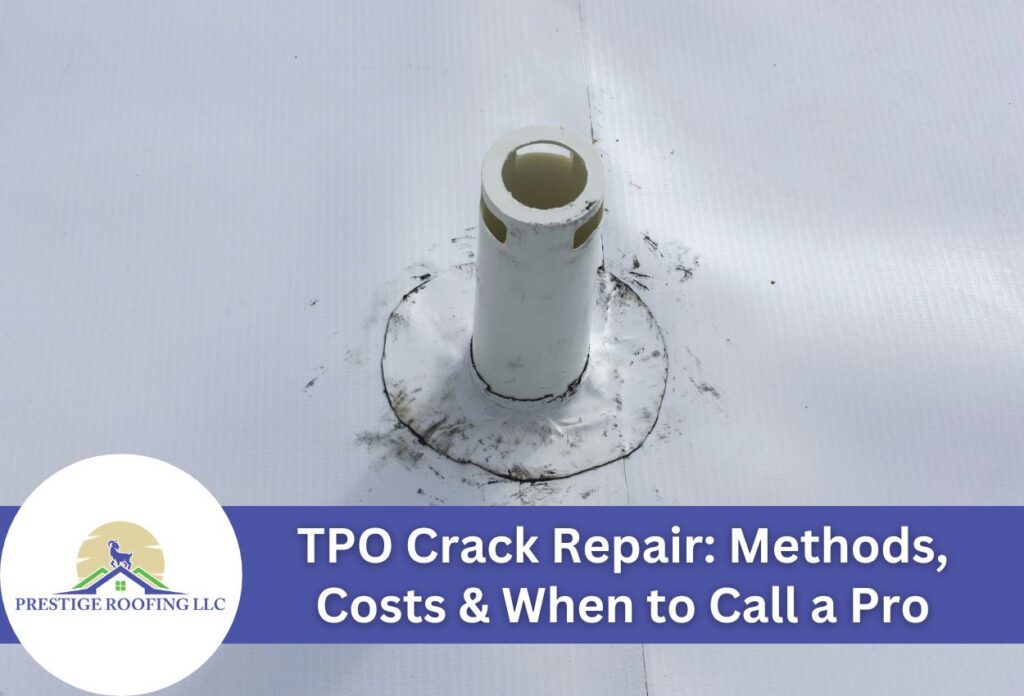

TPO crack repair is the process of patching splits, punctures, or seam failures in a thermoplastic polyolefin membrane before water finds its way into the roof assembly below. In Green Bay, winter temperatures that swing between 10 degrees and 30 degrees Fahrenheit create repeated freeze-thaw cycles that put constant stress on flat-roof membranes. That stress can split the reinforcing scrim inside the TPO layer, opening small cracks that grow fast.
Left alone for one to two seasons, even a minor crack can allow enough of a leak in to degrade insulation R-value and rot the roof deck beneath. For the flat and low-slope commercial roofs common across Green Bay, that kind of hidden damage adds up to expensive structural repairs down the line.
This article covers how TPO cracks form, the repair methods and materials used to fix them, what repairs typically cost, and how to decide when a professional roofer needs to step in.
*Please note, price ranges listed in this article may not reflect the final cost of your project. Prices are subject to change based on various factors such as local labor rates, material quality, and more. All costs established in this article are rough estimates based on average industry rates.
What Are the Main TPO Crack Repair Methods and Which Materials Work Best?
Heat-welded membrane patches outperform every other repair method for cracks longer than 2 inches, delivering bond strengths of 4 to 6 lbs per linear inch, two to three times stronger than TPO crack repair tape solutions rated at just 1 to 2 lbs per linear inch.
| Repair Method | Skill Level Required (1 to 5) | Typical Lifespan of Repair (years) | Temperature Requirement for Application ( degrees) | Best-Use Crack Size (inches) |
|---|---|---|---|---|
| TPO crack repair tape (e.g., Eternabond, OmniSeal) | 1 | 2 to 5 | 40 degrees to 100 degrees | Under 1 inch |
| Liquid adhesive patch (best adhesive for TPO roof crack repair) | 2 | 3 to 7 | 50 degrees to 90 degrees | Under 1.5 inches |
| Heat-welded membrane patch | 4 | 10 to 15 | 930 degrees to 1,020 degrees (welder setting) | 2 inches or longer |
| Professional strip-in repair | 5 | 15 to 20 | 930 degrees to 1,020 degrees (welder setting) | 2 inches or longer |
Tape-based products like Eternabond and OmniSeal work well for small cracks under 1 inch in low-traffic roof areas. They are fast, require no special tools, and hold up reasonably well through a few freeze-thaw cycles. Liquid adhesive patches add slightly more coverage but still fall short on larger splits.
For any crack reaching 2 inches or more, a heat-welded patch or professional strip-in repair is the only method that holds long enough to justify the labor cost. Green Bay’s wide seasonal temperature swings make weak repairs fail faster, so matching the method to the crack size saves money over time.
How Do You Fix Cracks in a TPO Membrane?
A successful TPO crack repair follows five steps, and skipping any one of them shortens the life of the patch by years. Follow this sequence for the strongest result.
- Safety inspection before touching anything: Walk the full roof area and check for soft spots, ponding water, or debris near the crack. Mark the damaged zone with chalk so you can see the full extent of the split before cutting any material.
- Surface cleaning with isopropyl alcohol or TPO-specific cleaner: Wipe at least 4 inches around the crack in all directions using a clean cloth and isopropyl alcohol (70% concentration or higher) or a manufacturer-approved TPO cleaner. Dirt and oils break adhesion. A dry, contamination-free surface is non-negotiable before any patch goes down.
- Measure and cut the patch to extend at least 2 inches beyond the crack on all sides: For a 3-inch crack, the minimum patch size is 7 inches wide. Use a straight edge and a sharp utility knife to cut the TPO patch material. Round the corners of the patch with scissors. Square corners peel up faster under thermal movement.
- Apply heat-weld or tape adhesive: For heat-welded patches, set the hot-air welder between 930 degrees and 1,020 degrees and move at a steady 1 to 2 inches per second. For tape-based repairs on cracks under 1 inch, press firmly from the center outward using a silicone roller to eliminate air pockets.
- Seam probe test to confirm the bond: Run a dull seam probe tool along the full edge of the patch within 5 minutes of welding while the material is still warm. Any edge that lifts requires immediate re-welding before the membrane cools.
Do not attempt repairs when outdoor temperatures are below 40 degrees, as adhesion drops sharply and heat welds cure unevenly in cold air. In Green Bay, average monthly lows rule out reliable repairs from roughly November through March. Schedule crack repairs between May and September for best results.
One permit note worth knowing: Wisconsin commercial roofing projects that alter more than 25% of the total roof area require a local building permit in Green Bay. Standard spot crack repairs almost always fall well below that threshold, but confirm with the city if the repair area is large.
How Much Does TPO Crack Repair Cost Per Square Foot in Green Bay?
Professional commercial roof repair cost per square foot in Green Bay runs $4 to $9 when performed by a licensed Wisconsin roofing contractor, compared to $7 to $14 per square foot for a full TPO membrane replacement in the Midwest. That gap makes quick crack repair the clear cost-saving choice for commercial property owners.
| Repair Option | Estimated Material Cost | Labor Cost | Total Cost Range Per Sq Ft | Expected Repair Lifespan (years) |
|---|---|---|---|---|
| DIY tape/adhesive repair | $0.15 to $0.40/sq ft | None | $0.15 to $0.40/sq ft | 2 to 5 |
| DIY heat-weld patch kit | $0.50 to $1.25/sq ft | None | $0.50 to $1.25/sq ft | 5 to 10 |
| Professional contractor repair (strip-in patch) | Included in the labor rate | Included in total | $4 to $9/sq ft | 15 to 20 |
DIY material costs look low on paper, but the lifespan gap tells the real story. A professional strip-in repair lasts three to four times longer than a tape-based patch, meaning fewer return trips and less cumulative damage from repeated moisture exposure.
Should You DIY a TPO Crack Repair or Hire a Contractor?
DIY repair is appropriate only when the crack is under 2 inches long, located away from seams, shows no visible scrim damage, and outdoor temperatures are at or above 40 degrees with no active leaking present. Any condition outside those limits calls for a licensed contractor.
- DIY is reasonable if the crack is under 2 inches: Small surface cracks away from factory seams, with no split scrim reinforcement visible and no water infiltration, are the only safe candidates for a TPO roofing crack repair DIY approach using tape or adhesive patch products.
- Avoid fastener rows during any DIY patch cutting: Mechanically attached TPO membranes use fastener rows spaced 12 to 18 inches apart. Cutting a patch without mapping those rows first can damage fasteners and destabilize a wide section of membrane, often causing more damage than the original crack.
- Hire a contractor if the crack crosses a factory seam: Seam failures, visibly split scrim reinforcement, or damage spanning more than one membrane panel require heat-welding equipment and professional technique. Tape-based fixes at seams fail within one to two freeze-thaw seasons.
- Hire a contractor if any leak has already occurred: Active water infiltration means moisture has already reached the insulation layer or deck below. A contractor must assess hidden damage before any surface repair holds long-term.
When in doubt, a professional commercial roof inspection costs far less than a failed DIY patch that allows water to reach the roof deck. Prestige Roofing LLC can evaluate crack location, scrim condition, and the seam’s structural integrity before recommending the right repair path.
How Much Can Early TPO Crack Repair Save You Over the Roof’s Lifespan?
Addressing a TPO crack in its first season costs $400 to $900 on average for a small professional repair compared to $15,000 to $40,000 for a full membrane replacement on a 10,000 sq ft commercial building. That difference represents a potential 97%+ cost avoidance when repairs happen early rather than after damage spreads.
TPO membranes are designed to last 20 to 30 years under normal conditions. But unaddressed cracks allow in leaks that can cut that service life by 5 to 10 years. One deferred repair does not just damage a small section. It accelerates wear across the entire roofing system, moving a full replacement years closer than it needs to be.
Catching a crack at the hairline stage, before it reaches 2 inches, keeps the repair in the low-cost professional or DIY range rather than requiring full panel replacement. Bi-annual inspections each spring and fall run approximately $150 to $400 per visit from a licensed roofing contractor. That small recurring cost is what makes early detection realistic. A crack found at half an inch costs a fraction of what the same crack costs after a Green Bay winter pushes it through the membrane’s scrim layer and into the insulation below.
Ready to Fix Your TPO Roof? Contact Green Bay’s Commercial Roofing Experts
Catching a TPO crack now before November temperatures drop below 40 degrees and close the repair window until spring is the difference between a $400 to $900 repair and a five-figure membrane replacement. Prestige Roofing LLC works with commercial property owners across Green Bay and northeast Wisconsin to assess crack severity, confirm the scrim’s structural integrity, and complete heat-welded repairs during the May through September window when conditions allow lasting results.
Don’t wait until winter forces the issue. Schedule a TPO inspection now while repair conditions are still right.
Not ready to schedule? Learn more about TPO crack repair services.