How Long Does a TPO Roof Installation Take on a Commercial Building in Green Bay?
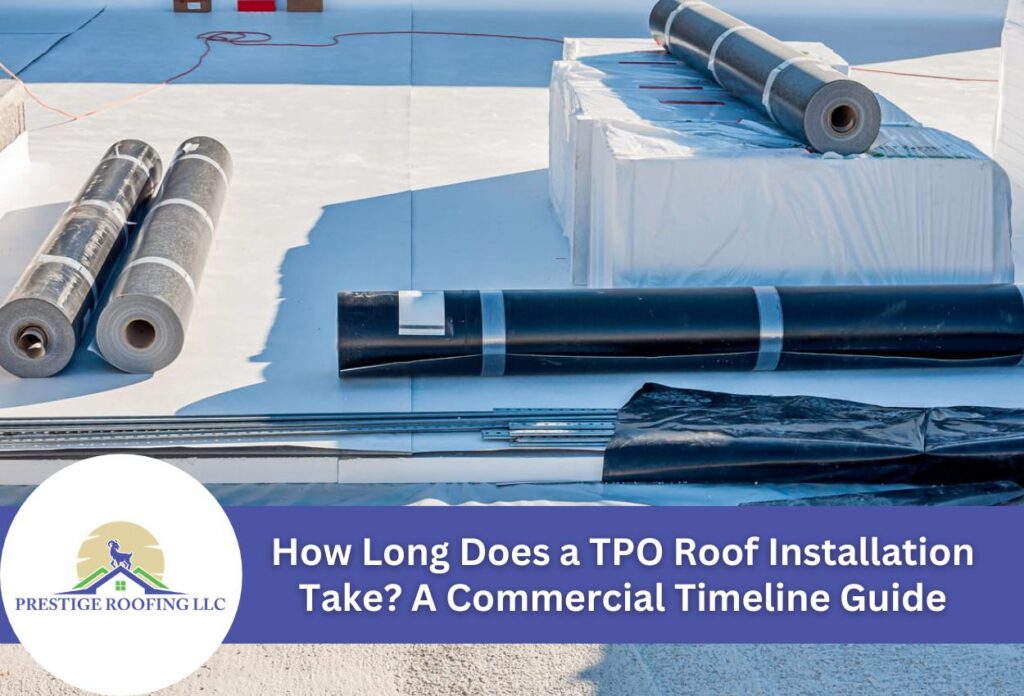

Most commercial TPO roof installations in Green Bay take 1 to 5 days for buildings under 20,000 square feet, while larger or more complex projects typically run 1 to 3 weeks. Those ranges hold under good conditions: the right weather, a clean roof deck, and a straightforward layout. Change any of those factors and the timeline shifts.
Green Bay’s climate narrows the practical installation window to roughly late April through October. Below-freezing temperatures make heat-welding TPO seams unreliable, because the membrane stiffens and the welder can’t produce a consistent, watertight bond. That’s not a risk worth taking on a commercial building. If the existing membrane needs to come off first, add 1 to 2 days to any estimate. Tear-off conditions, roof deck repairs, and insulation replacement all feed into the final number.
*Please note, price ranges listed in this article may not reflect the final cost of your project. Prices are subject to change based on various factors such as local labor rates, material quality, and more. All costs established in this article are rough estimates based on average industry rates.
What Factors Most Affect TPO Roofing Installation Time Per Square Foot?
Crew size is the single biggest driver of TPO installation speed, but gaps, tear-off, roof deck repairs, and seam footage can add days even with a large crew. A 10,000 square foot roof that looks simple on paper can stretch from 2 days to 5 or more once those variables stack up. A pre-installation inspection, typically 2 to 4 hours, is the most reliable way to catch those issues before they cause mid-project delays. Scheduling a commercial roof inspection before work begins is the best way to surface those hidden variables early.
| Crew Size | Install Time per Sq Ft (days) | Estimated Days for 10,000 Sq Ft |
|---|---|---|
| 2-person crew | 0.008 to 0.010 days/sq ft | 8 to 10 days |
| 4-person crew | 0.004 to 0.006 days/sq ft | 4 to 6 days |
| 6-person crew | 0.002 to 0.004 days/sq ft | 2 to 4 days |
Four Variables That Add Time
- Gap flashing (HVAC units, drains, pipes): 0.5 to 1.5 hours per gap
- Full tear-off on a 10,000 sq ft roof: 1 to 2 additional days
- Roof deck repairs (rotted or damaged sections): 0.5 to 1 hour per affected area, plus material time
- High seam linear footage (complex layouts): adds hours per additional 100 linear feet of welded seams
Buildings with more than 15 gaps or roof decking that needs repair can push a standard 2-day job to 5 or more days. Knowing this before work starts, not after, keeps the schedule and budget on track.
How Many Days Does a TPO Roof Replacement Take Compared to Installation Over an Existing Roof?
A full tear-off with a roof deck repair takes the longest of any TPO project type, typically 4 to 7 crew days for a building in the 10,000 to 20,000 square foot range, while a simple overlay on new construction can finish in 1 to 3 days. Learn more about what goes into a commercial roof replacement to understand how scale affects the timeline.
| Project Type | Typical Building Size | Total Crew Days | Estimated Disruption to Operations |
|---|---|---|---|
| New construction overlay | 5,000 to 20,000 sq ft | 1 to 3 days | Minimal: 2 to 6 hours per HVAC unit during flashing |
| Recover over existing single-ply membrane | 5,000 to 20,000 sq ft | 2 to 4 days | Low: 2 to 6 hours per HVAC unit during flashing |
| Full tear-off and replacement | 5,000 to 20,000 sq ft | 3 to 5 days | Moderate: 2 to 6 hours per HVAC unit during flashing |
| Tear-off with roof deck repair | 5,000 to 20,000 sq ft | 4 to 7 days | Higher: noise and 2 to 6 hours per HVAC unit during flashing |
Building codes generally limit the number of existing roof coverings that may remain before a recover is no longer permitted, making the existing roof assembly an important factor in determining whether a recover or full tear-off is appropriate. Confirming the existing roof conditions through an on-site inspection and available building records before bidding is the most reliable way to determine which approach applies. Most building operations can continue during TPO work because crews stay on the roof exterior, but plan for brief HVAC shutdowns of 2 to 6 hours per unit when flashing work is underway.
What Is the TPO Roof Installation Timeline for a Flat Roof When Weather Is a Factor?
Most TPO manufacturers require ambient and roof deck temperatures of at least 40 degrees Fahrenheit for heat-welded seams, with welding conditions working best between 50 degrees and 90 degrees. Green Bay frequently experiences temperatures below 40 degrees from November through March, making that period less favorable for new TPO installations unless manufacturer cold-weather installation procedures can be followed. When temperatures drop below that threshold, the membrane stiffens, and the heat welder cannot produce a consistent, watertight bond. That is not a gamble worth taking on a commercial roof.
When to Schedule and How Much Buffer to Build In
The safest project start window in Green Bay runs from May 15 through August 31. That period gives the highest number of usable workdays and avoids the temperature swings that cause roof deck moisture issues. A wet or frost-affected roof deck needs 1 to 3 days of drying time before membrane installation can begin: adding that to a tight schedule can push completion back by a full week.
Even during the May through September roofing season, weather delays are a real budget and scheduling factor. Rain, high winds above 25 mph, and sudden temperature swings account for roughly 10 to 15 delay days in a typical Green Bay season. Build a 10% to 15% schedule buffer into any TPO project timeline to account for those lost days without throwing off the rest of the project. A project scale for 5 days should have 5.5 to 6 days of float built into the contract before work begins.
How Long Does a TPO Membrane Roof Take to Install Across Different Commercial Building Sizes?
A TPO roof on a building under 5,000 square feet can be completed in 1 to 2 days under standard conditions, while a 50,000+ square foot project typically runs 2 to 4 weeks depending on crew size and whether tear-off is required. The table below gives building owners in Green Bay a practical starting point for scheduling before permits, weather buffers, or site complications are added in.
| Building Size | Install Days (No Tear-Off) | Install Days (With Tear-Off) | Recommended Crew Size |
|---|---|---|---|
| Under 5,000 sq ft | 1 to 2 days | 2 to 3 days | 2 to 3 workers |
| 5,000 to 10,000 sq ft | 2 to 3 days | 3 to 5 days | 3 to 4 workers |
| 10,000 to 20,000 sq ft | 3 to 5 days | 4 to 7 days | 4 to 6 workers |
| 20,000 to 50,000 sq ft | 6 to 12 days | 8 to 16 days | 6 to 10 workers |
| 50,000+ sq ft | 14 to 21 days | 18 to 28 days | 10+ workers |
Green Bay commercial roofing contractors most commonly specify 60-mil TPO membrane for Wisconsin’s temperature swings because it meets the longevity standard for a 20-year warranty target. It costs 5% to 10% more in materials than 45-mil TPO, but it does not add meaningful time to the installation schedule, so the upgrade is largely a material cost decision, not a scheduling one.
Permit processing times for commercial roof replacement projects in Green Bay vary depending on the project and the reviewing authority, so contractors should account for potential permitting lead times when scheduling work. Factor that lead time into any scheduling conversation before requesting bids, especially if the project needs to finish before winter closes the installation window in late October.
Is a Faster TPO Installation Worth the Cost, and What ROI Should You Expect?
A 10,000 square foot TPO project ranges from roughly $45,000 to $110,000 depending on scale new installation runs $5.50 to $8.50 per square foot, a recovery over an existing membrane runs $4.50 to $7.00 per square foot, and a full tear-off replacement runs $7.00 to $11.00 per square foot. Those numbers look large upfront, but the math changes when spread across the life of the roof.
| Project Type | Cost per Sq Ft | 10,000 Sq Ft Total | Annualized Cost (25 Years) |
|---|---|---|---|
| Recover over existing membrane | $4.50 to $7.00 | $45,000 to $70,000 | $1,800 to $2,800/year |
| New installation | $5.50 to $8.50 | $55,000 to $85,000 | $2,200 to $3,400/year |
| Full tear-off replacement | $7.00 to $11.00 | $70,000 to $110,000 | $2,800 to $4,400/year |
| Failing roof patch and repair | N/A | N/A | $3,000 to $8,000/year |
A properly installed 60-mil TPO roof in a Wisconsin climate carries manufacturer warranties of 15 to 30 years. An $80,000 installation spread over 25 years costs about $3,200 per year, and that figure sits at the low end of what patch-and-repair costs on a failing roof commonly run before full replacement becomes unavoidable.
Expedited scheduling with a larger crew adds roughly 10% to 20% to labor costs, about $1,500 to $4,000 on a mid-size commercial project, but it can close out the job before Green Bay’s weather window shuts down in late October. That premium is often worth it. A weather delay that pushes a project into November can force a full stop until spring, turning a $2,000 scheduling decision into a much larger problem. When comparing bids, ask contractors to break out labor versus material costs so the value of a faster crew is easy to see.
Ready to Schedule Your TPO Roof Installation in Green Bay?
Getting your project on the calendar early matters. Green Bay’s peak TPO installation window runs May through September, and that season books quickly. A weather delay pushed into November can shut down a project until spring, turning a manageable scheduling decision into an expensive one.
Prestige Roofing LLC provides free on-site estimates for commercial property owners in the Green Bay area. Every estimate includes a timeline projection based on your building size, existing roof condition, and preferred start window so you know exactly what to expect before work begins.
Get your free roofing estimate.
Not ready to schedule? Learn more about TPO roof installation.