What Roofing System Handles Ponding Water Better on a Flat or Low-Slope Roof?

TPO and PVC outperform EPDM and modified bitumen when ponding water is a recurring problem on a flat or low-slope roof. The National Roofing Contractors Association flags standing water that remains longer than 48 hours after rainfall as a threshold for concern, and in Green Bay, that threshold gets tested often. Snowmelt, spring runoff, and summer thunderstorms routinely push water onto flat commercial and multifamily roofs across Brown County, where limited slope and slow drainage can leave low spots wet for days at a time.
The geographic setting near the Fox River and the Bay of Green Bay adds to the challenge. Roofs with even minor drainage problems tend to collect water faster and dry out slower in this region. Picking the wrong membrane for those conditions can shorten roof life and lead to seam failures, blistering, and leaks that add up over time.
*Please note, price ranges listed in this article may not reflect the final cost of your project. Prices are subject to change based on various factors such as local labor rates, material quality, and more. All costs established in this article are rough estimates based on average industry rates.
How Do TPO, EPDM, PVC, and Modified Bitumen Actually Perform Under Standing Water?
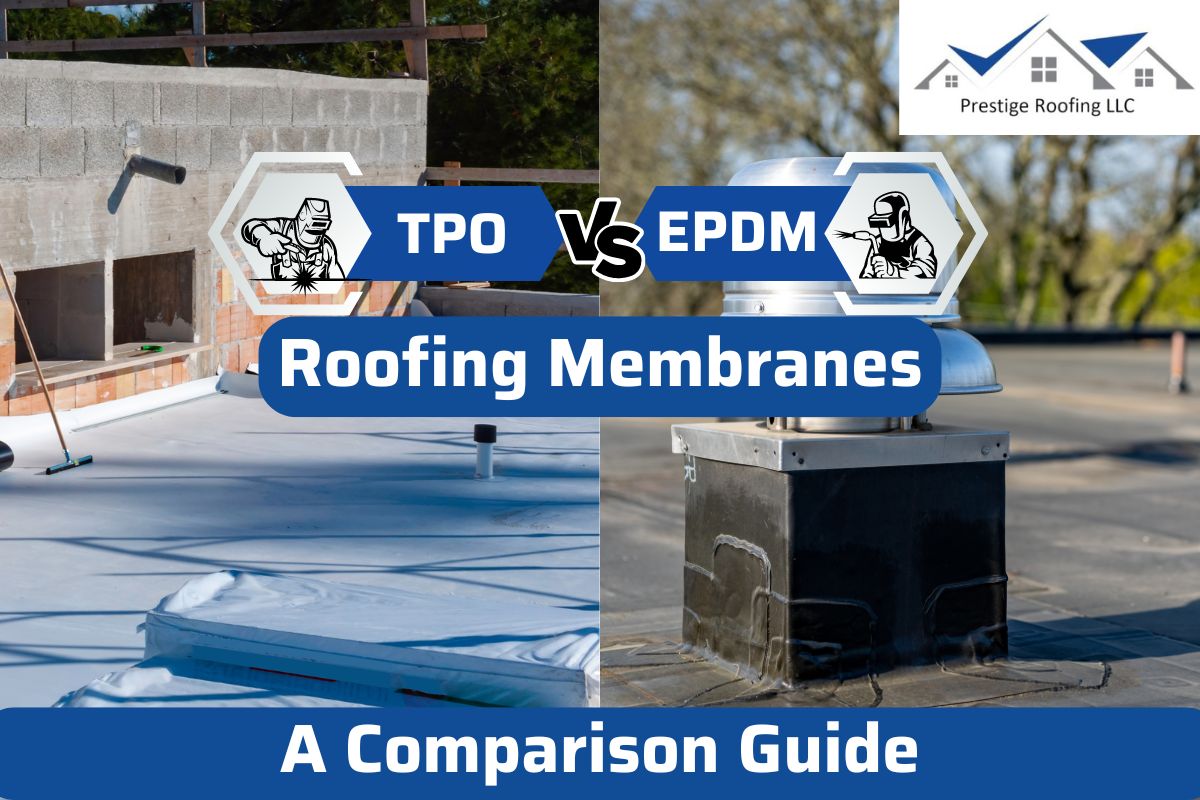
TPO heat-welded seams achieve bond strengths of 40 to 50 lbs per inch width two to five times stronger than EPDM tape-bonded seams at 10 to 20 lbs per inch, making the seam’s structural integrity under prolonged saturation the single biggest performance gap between these four systems.
| Membrane | Seam Type | Water Resistance | Thickness Range (mils) | Freeze-Thaw Resistance | UV / Ponding Degradation Risk |
|---|---|---|---|---|---|
| TPO | Heat-welded | Excellent | 45 to 80 mils | Good flexibility in cold temps | Low UV-reflective surface slows down breakdown |
| EPDM | Tape-bonded or adhesive | Fair | 45 to 90 mils | Good rubber stays flexible | Moderate seams vulnerable under sustained saturation |
| PVC | Heat-welded | Excellent | 40 to 80 mils | Fair can become brittle below 0 degrees | Low chemical resistance adds protection |
| Modified Bitumen | Torched or cold-applied laps | Fair | 150 to 180 mils (2-ply typical) | Fair lap seams can delaminate with repeated temperature changes | High granular surface traps moisture and accelerates seam delamination with chronic ponding |
For Green Bay roofs where ponding is a recurring problem, seam strength is the deciding factor, and that is where EPDM falls short at 10 to 20 lbs per inch versus TPO’s 40 to 50 lbs per inch. PVC matches TPO on seam performance but runs 15% to 25% more per square foot installed, which matters on larger roof areas. Modified bitumen carries the highest long-term ponding risk because its granular surface actively traps standing water, speeding up seam delamination over multiple wet seasons. Prestige Roofing LLC can assess which membrane fits a specific roof’s drainage conditions and slope before any work begins.
How Long Can Water Pond on a Flat Roof Before It Causes Damage?
The International Building Code and most membrane manufacturer warranties treat any standing water that remains more than 48 hours after rainfall as a deficiency requiring correction, not a minor cosmetic issue. That 48-hour threshold matters in Green Bay, where snowmelt and blocked drains can leave low spots wet for days at a stretch.
The risks fall into two separate categories: membrane degradation and structural damage. On the membrane side, EPDM shows measurable softening and swelling after 30 to 90 days of continuous immersion, per the manufacturer’s lab data. Prolonged ponding beyond the 48-hour mark can void warranties on EPDM and modified bitumen systems within 2 to 5 years. On the structural side, the numbers get serious fast. Standing water weighs approximately 5.2 lbs per square foot per inch of depth. A 2-inch pond across a 2,000 sq ft roof adds over 20,000 lbs of unplanned weight. For older postwar commercial buildings in the Green Bay metro area with aging structural decks, that kind of unplanned weight can cause deck deflection and accelerate interior leak damage well before any membrane failure is visible.
These two risks do not always show up at the same time. A roof can be chemically softening at the seams for months before a deck problem becomes obvious. That is why regular drainage inspections after heavy rain or snowmelt are advised for any flat or low-slope roof in Brown County, not just roofs that already show signs of wear.
Which Flat Roof Material Is Most Waterproof for Pooling Water in Green Bay’s Climate?
PVC lasts the longest under chronic ponding conditions, 25 to 30 years, followed by TPO at 20 to 27 years, making both heat-welded systems the strongest options for Green Bay flat roofs with known drainage problems. Northeast Wisconsin averages 50 to 70 freeze-thaw cycles per year, and that repeated stress shortens membrane life faster than ponding alone. The table below shows how each system holds up when both factors are present at the same time.
| Membrane | Expected Lifespan Under Chronic Ponding | Low-Temp Flexibility |
|---|---|---|
| PVC | 25 to 30 years | Flexible to -40 degrees |
| TPO | 20 to 27 years | Flexible to -40 degrees |
| EPDM | 15 to 20 years (reduced from standard 25-year rating) | Can crack at seams below -20 degrees without cold-weather products |
| Modified Bitumen | 10 to 16 years | Lap seams prone to delamination with repeated temperature changes |
TPO and PVC both use heat-welded seams and stay flexible at temperatures as low as -40 degrees, a real advantage through Green Bay winters. Standard EPDM can become brittle and crack at seams below -20 degrees without cold-weather products, and its lifespan drops from a standard 25-year rating down to 15 to 20 years when ponding is chronic. Modified bitumen performs the worst under these combined conditions, topping out at 10 to 16 years.
For Green Bay flat roofs with known drainage issues, TPO is the stronger everyday choice over EPDM heat-welded seam durability, temperature flexibility down to -40 degrees, and lower long-term maintenance costs give it a clear edge where standing water is a recurring problem. PVC edges out TPO on raw lifespan but costs more per square foot installed, which matters on larger roof areas. Prestige Roofing LLC can help property owners weigh those trade-offs against a specific roof’s size, slope, and drainage conditions.
How Do You Prevent Ponding Water on a Flat Roof Before It Becomes a Roofing Emergency?
Five targeted corrections, starting with achieving a minimum 1/4 inch per foot slope, can stop ponding before it voids a membrane warranty or threatens the structural deck. Drainage corrections are most cost-effective when completed during a full commercial roof membrane replacement rather than as a standalone repair.
- Reslope with tapered insulation to meet IBC minimums: The International Building Code requires a minimum 1/4 inch per foot slope on low-slope roofs. Tapered insulation adds $1.50 to $3.00 per square foot to project costs, but can extend membrane life by 5 to 10 years by eliminating chronic low spots, making it one of the smartest additions at replacement time.
- Add or relocate interior drains and scuppers: Interior drains on low-slope roofs should be spaced no more than 100 feet apart per SMACNA guidelines. If existing drains are undersized or positioned away from low spots, water will find a place to sit regardless of membrane quality.
- Install crickets and saddles around HVAC curbs and gaps: Rooftop equipment creates dam points where water collects. Crickets redirect water around curbs before it has a chance to pond against seams or flashings.
- Clear drains twice a year on a fixed schedule: In Green Bay, clean drains before the first hard freeze October is the target month, and again after snowmelt clears in April. Debris buildup in a single drain can back up water across hundreds of square feet of membrane.
- Schedule a post-storm inspection within 48 to 72 hours after any rainfall exceeding 1 inch: That 48-hour window matches the threshold used by the International Building Code and most membrane manufacturers. Catching standing water in that window allows drainage corrections before saturation reaches seams or the structural deck.
Knowing how to prevent ponding water on a flat roof comes down to slope, drainage placement, and consistent maintenance, and all three are most cost-effective to address during a full membrane replacement. Prestige Roofing LLC evaluates drainage layout and slope conditions before any flat roof project in Green Bay to make sure corrections are built into the job from the start.
What Does It Cost to Replace a Flat Roofing System That Has Chronic Ponding Damage in Green Bay?
TPO delivers the strongest balance of installed cost, ponding resistance, and lifespan for most Green Bay flat roofs, running $6.50 to $9.00 per square foot installed versus PVC at $7.50 to $10.50 per square foot for the premium option. The table below breaks down all four major systems across the metrics that matter most when ponding damage has already occurred.
| Membrane | Installed Cost (Green Bay) | Typical Warranty Length | Estimated Lifespan of Chronic Ponding | 20-Year Cost Per Year of Ownership |
|---|---|---|---|---|
| TPO | $6.50 to $9.00/sq ft | 15 to 20 years | 20 to 27 years | $0.24 to $0.45/sq ft/year |
| EPDM | $5.50 to $8.00/sq ft | 10 to 20 years | 15 to 20 years | $0.28 to $0.53/sq ft/year |
| PVC | $7.50 to $10.50/sq ft | 15 to 20 years | 25 to 30 years | $0.25 to $0.42/sq ft/year |
| Modified Bitumen | $4.50 to $7.00/sq ft | 10 to 15 years | 10 to 16 years | $0.28 to $0.70/sq ft/year |
Modified bitumen looks affordable at $4.50 to $7.00 per square foot installed, but its 10 to 16 year lifespan under chronic ponding conditions means more frequent replacement cycles, and those cycles add up fast. Deferred replacement of a failing membrane with chronic ponding averages $3 to $8 per square foot in interior water damage remediation per claim, based on commercial restoration industry data. That remediation range can erase any upfront savings from choosing a lower-cost membrane that fails ahead of schedule. For buildings where drainage improvement is not feasible, PVC is the right premium option, but for most Green Bay flat roofs, TPO offers the better long-term value. Prestige Roofing LLC can review a specific roof’s drainage conditions and recommend the system that fits both the building and the budget.
Should You Repair or Replace a Flat Roof With Ongoing Ponding Problems?
Replace, not repair, when a flat roof meets two or more of the five criteria below. Repair-only approaches on roofs meeting that threshold typically require repeat repairs within 2 to 4 years, making full replacement the lower total cost over 10 years in most cases.
- Membrane is 15+ years old: Age alone does not trigger replacement, but an aging membrane combined with any other factor below tips the math toward a full system swap rather than patching what remains.
- Ponding covers more than 25% of the roof field: At that point, drainage corrections alone rarely solve the problem without addressing the underlying slope, and a repair budget can quickly approach replacement costs.
- Seams show lapping, blistering, or adhesive failure in more than 3 locations: Multiple seam failures across the roof field signal system-wide breakdown, not isolated damage. Spot repairs at this stage buy months, not years.
- Interior leaks have occurred in the past 12 months: Active interior leaks mean water has already moved past the membrane and into the building assembly, a condition that adds up fast without full corrective action.
- Insulation moisture content exceeds 25% as measured by an infrared scan or core test: Wet insulation loses R-value, adds weight to the deck, and accelerates membrane deterioration from below. A professional commercial roof inspection costs $300 to $700 for most commercial flat roofs under 10,000 sq ft and can identify wet insulation before it leads to deck deterioration, making it a low-cost diagnostic step before committing to repair versus replace.
Two or more of these conditions present at the same time are the clearest signal that replacement will cost less than repeated repairs over the next decade. An infrared scan is the fastest way to confirm how many criteria a roof actually meets before any budget decision is made.
Ready to Solve Your Flat Roof Ponding Problem in Green Bay?
Standing water that sits past the 48-hour threshold can void your membrane warranty and push remediation costs to $3 to $8 per square foot, damage that a single inspection can help you avoid. Prestige Roofing LLC serves Green Bay and Brown County property owners with flat roof assessments that cover TPO roofing, EPDM roofing, and PVC membrane options, plus drainage corrections, all in one visit.
Schedule your free roof inspection.
Not ready to schedule? Learn more about emergency flat roof services.