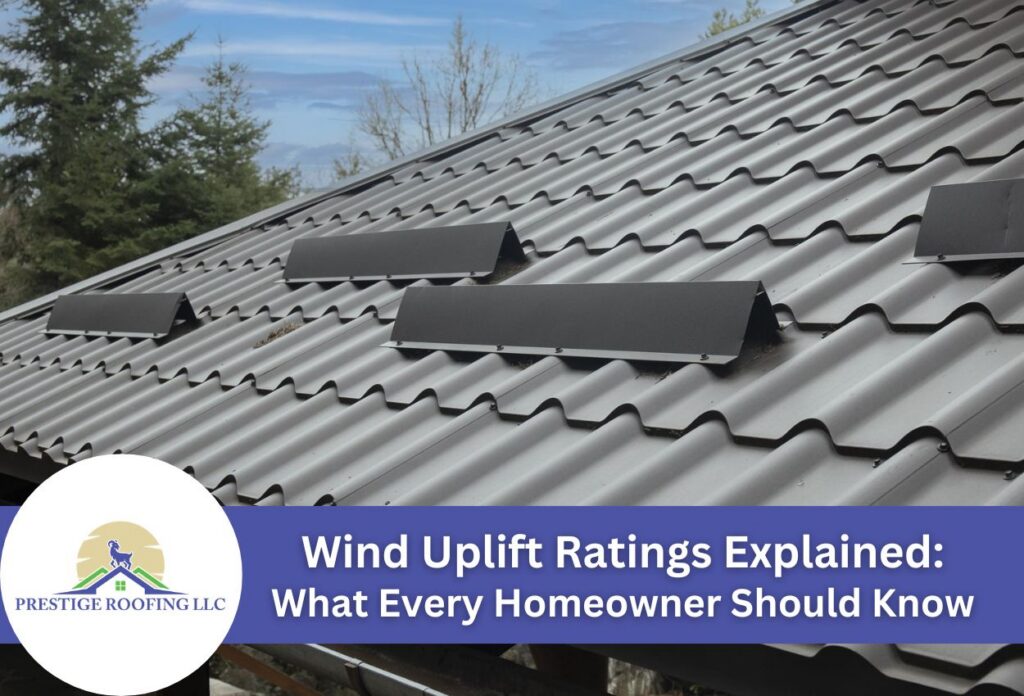

Wind uplift is negative pressure measured in pounds per square foot (psf) that pulls a roof away from the roof deck, and roof edges, corners, and eaves commonly experience 2 to 3 times the uplift pressure of the flat field area in the center of the roof. That distinction matters more than most property owners realize. A roof can fail at its edges long before the middle shows any damage, which is why ratings are based on tested pressure resistance, not wind speed alone.
Green Bay and Brown County sit within the Lake Michigan basin, where open terrain and flat topography increase wind loading compared to sheltered inland Wisconsin locations. Broad roof planes, proximity to water, and open exposure all add to the pressure a roof assembly has to resist during storms. For homes and businesses here, uplift ratings are a practical design factor, not just a code checkbox.
*Please note, price ranges listed in this article may not reflect the final cost of your project. Prices are subject to change based on various factors such as local labor rates, material quality, and more. All costs established in this article are rough estimates based on average industry rates.
How Are Wind Uplift Ratings Tested and What Do the Numbers Actually Mean?
Two separate rating systems dominate the roofing market, and they measure different things: ASTM D3161/D7158 classifications rate shingles by equivalent wind speed, while FM and UL pressure-based ratings measure how much force an entire roof assembly can resist in pounds per square foot (psf). Under ASTM D7158, Class D equals 90 mph, Class F equals 110 mph, and Class H equals 150 mph. Under FM and UL ratings, a 1-60 rating means the assembly withstands 60 psf, a 1-90 means 90 psf, and a 1-120 means 120 psf. These psf ratings and mph ratings are not directly interchangeable: they describe different testing conditions and different parts of the roof.
That difference matters a lot when reading a product label or spec sheet. A label showing “ASTM D7158 Class H” tells a buyer that the shingle tab or panel bond was tested to resist wind equivalent to 150 mph. An entry showing “FM 1-90 Approved” tells a buyer that the full roof assembly, roof deck, fasteners, insulation, and membrane together were tested to resist 90 psf of uplift pressure. A high-rated shingle installed over a deteriorated or undersized roof deck does not produce a high-rated system because the ASTM rating covers only the shingle bond, not what it’s anchored to.
Learning how to read wind uplift ratings on roofing materials comes down to one question: does this number describe a single component or the whole assembly? Shingle spec sheets reference ASTM classifications. Commercial low-slope products reference FM or UL assembly numbers. Knowing which system applies to a product prevents the common mistake of assuming a top-rated shingle automatically creates a wind-resistant roof from top to bottom.
How Do Wind Uplift Ratings Compare Across Metal Roofing Systems, Shingles, and Flat Roofs?
Standing seam metal roofing systems consistently achieve the highest tested uplift ratings of any common roofing type, with concealed-clip assemblies reaching FM 1-135 or higher, well above the FM 1-60 to FM 1-90 range typical of exposed-fastener metal panels and many single-ply flat roofing systems. For properties considering this option, residential metal roof installation provides a closer look at how these systems are specified and installed.
| Roofing Type | Common Rating Standard | Typical Tested Uplift Range | Vulnerable Conditions |
|---|---|---|---|
| Architectural shingles | ASTM D7158 Class D to H | 60 to 150 mph equivalent | Roof edges, corners, and eaves: roof deck deterioration |
| Standing seam metal (concealed clip) | FM 1-90 to 1-180 | Up to 180 psf tested | Exposed fastener substitution: improper clip spacing |
| Exposed-fastener metal panels | FM 1-60 to 1-90 | 60 to 90 psf tested | Fastener back-out over time: edge zones |
| Single-ply flat membrane TPO or EPDM (fully adhered) | FM 1-90 to 1-120 | 90 to 120 psf depending on attachment method | Seam failure: perimeter edges and corners |
| Single-ply flat membrane TPO or EPDM (mechanically attached) | FM 1-60 to 1-90 | 60 to 90 psf typical | Fastener pullout: insulation board attachment |
For flat roofs, the attachment method makes a large difference. Fully adhered single-ply membranes typically achieve 30% to 40% higher uplift ratings than mechanically attached systems on equivalent roof decks, because the glued bond distributes pressure across the full surface rather than concentrating it at fastener points. On metal roofing systems, the gap between concealed-clip and exposed-fastener systems is just as wide as concealed-clip assemblies commonly test at FM 1-135 or higher, while exposed-fastener panels often top out at FM 1-60 to FM 1-90. For Green Bay property owners weighing long-term wind performance, that rating gap is worth factoring into the decision alongside installation costs.
What Wind Uplift Resistance Ratings Are Required in Northeast Wisconsin?
Wisconsin follows the International Residential Code (IRC) and International Building Code (IBC) as adopted by the state, with the Green Bay metro area generally falling in ASCE 7 wind exposure categories B or C, depending on site terrain, and design wind speeds in the range of 90 to 115 mph for most residential structures in Brown County. Exposure category C applies to open terrain flat lots, sites near water, and locations without significant wind breaks, and those sites carry higher design loads than more sheltered category B locations. For wind uplift resistance ratings by region, that exposure category difference directly affects which assembly ratings meet code, not just which wind speed number appears on a shingle wrapper.
- Permits for re-roofing and roof deck repair: Wisconsin requires permits for structural roof deck repair and re-roofing services in most jurisdictions. Commercial projects specifying FM-rated assemblies may require assembly documentation, product data sheets, and FM approval numbers submitted at permit review. Have those ready before submitting.
- Assembly ratings vs. component ratings: A permit reviewer may accept a shingle’s ASTM D7158 Class D or Class H rating for residential work, but commercial submittals typically need the full FM assembly number, not just a membrane or panel rating alone.
- Pre-2000s houses: Many Green Bay homes built before the 2000s predate enhanced nailing schedules and high-wind roof deck attachment requirements. The roof deck is part of the tested system. A rated replacement assembly installed over worn sheathing or inadequate fastener spacing will not perform to its listed rating.
Before selecting a rated replacement assembly for an older home, a contractor should assess roof deck condition, existing sheathing thickness, and fastener spacing because fixing those first is what allows the new assembly to actually perform at its rated value.
What Does Wind Uplift Rating Mean for Shingles When Choosing Between Products?
Wind uplift rating for shingles describes how much wind force the shingle bond can resist before tabs or panels separate from the roof deck, and for most Green Bay residential roofs, ASTM D7158 Class F (110 mph equivalent) is a reasonable minimum, while exposed or high-profile locations should target Class H (150 mph equivalent). Use this five-point checklist when comparing products.
- ASTM class relative to local wind exposure: Class F (110 mph) meets most residential needs in Brown County, but sites near open water, on elevated terrain, or with minimal wind breaks warrant Class H (150 mph). 3-tab shingles are typically rated Class D (90 mph equivalent), a meaningful step down from architectural or impact-resistant options that commonly reach Class F or Class H. Homeowners evaluating their options can review asphalt shingle roofing for product-level detail on available ratings.
- Manufacturer nailing requirements: A six-nail pattern can more than double field uplift resistance compared to a four-nail pattern, depending on the product.
- Roof pitch: Pitches above 6:12 create different pressure distributions across the surface. Many manufacturers publish separate uplift specifications for steep-slope applications, so check the product’s technical data sheet for pitch-specific limits before selecting.
- Roof deck condition: A shingle rated Class H installed over deteriorated sheathing or corroded fasteners may perform at Class D or lower, because the ASTM rating applies to the shingle bond, not what it anchors to. Roof deck condition should be confirmed before any rated product is specified.
- Insurance requirements: Some Wisconsin insurers offer premium discounts of 5% to 15% for Class F or Class H rated shingles. Ask the insurer for qualifying product criteria before finalizing a product selection.
Standard shingle warranties may cover wind damage up to 60 or 70 mph, while enhanced wind warranties tied to Class H products can cover up to 130 mph when installed per specification, but incorrect nail placement and insufficient attic ventilation are common conditions that void those warranties. Match the product rating to the site, confirm the roof deck can support that rating, then verify warranty terms before signing off on a product choice.
Does Upgrading to a Higher Wind Uplift Rating Save Money Over Time?
Yes, higher-rated roofing options cost more upfront but often cost less per year over their full lifespan, and that gap narrows further once storm repair costs are added to lower-rated products.
| Roofing Option | Approximate Installed Cost per Square (100 sq ft) | Wind Rating Achieved | Expected Lifespan in Green Bay Climate | Notable Financial Benefit |
|---|---|---|---|---|
| 3-tab shingle | $250 to $350/sq | Class D (90 mph equivalent) | 15 to 20 years | Lower upfront cost: higher long-term replacement frequency |
| Architectural shingle Class F | $350 to $500/sq | Class F (110 mph equivalent) | 25 to 30 years | Common insurance credit eligibility |
| Class H impact/wind-rated shingle | $500 to $700/sq | Class H (150 mph equivalent) | 30+ years | Insurance discount 5% to 15% annually: reduced storm claim likelihood |
| Standing seam metal | $900 to $1,400/sq | FM 1-90 or higher | 40 to 60 years | Lowest lifecycle cost per year |
Standing seam metal at a $1,100/sq average across a 50-year lifespan runs roughly $22/sq/year. A 3-tab shingle at $300/sq replaced every 17 years costs roughly $17.60/sq/year before any storm repair costs are added. Once one or two storm repairs are factored in, that $4.40/sq/year gap narrows or reverses entirely, making the metal option less expensive over the full period. Green Bay homeowners who have already filed wind damage claims should also know that some insurers now require an upgrade to Class F or Class H shingles at replacement, making the higher-rated option effectively mandatory at renewal and removing cost comparison from the decision altogether.
Ready to Choose the Right Wind-Rated Roof for Your Green Bay Property?
Choosing the right wind uplift rating is only part of the decision: roof deck condition, fastener spacing, and your site’s exposure category determine whether a rated assembly actually performs at its listed value. Prestige Roofing LLC serves Green Bay and the northeast Wisconsin area with site-specific assessments that look at all three factors, not just shingle brand selection.
Get a free estimate today and find out whether your current roof deck and fastening pattern can support a Class H or FM-rated upgrade before a storm makes that decision for you.
Request a free roofing estimate.
Not ready to schedule? Learn more about wind-rated roofing options.
Frequently Asked Questions
Got questions about your roof? We’ve got answers. From maintenance tips to insurance claims and repair timelines, our FAQ section covers the most common concerns homeowners have. Get informed and make confident decisions about protecting your home.
People Also Ask
Does roof shape affect how wind uplift ratings apply to my home?
Yes, hip roofs generally perform better under wind uplift than gable roofs because the angled planes reduce edge exposure and distribute pressure more evenly. Gable ends create large flat surfaces that catch wind directly, increasing suction at rakes and eaves beyond what a standard field-area rating accounts for.
Can ice dam damage weaken a roof's ability to meet its rated wind uplift resistance over time?
It can. Repeated freeze-thaw cycling, common in Green Bay winters, can loosen fasteners, delaminate sheathing, and degrade adhesive strips on shingles, all components on which the uplift rating depends. A roof that tested at Class F or FM 1-90 when new may no longer perform at that level after seasons of ice dam stress.
Do wind uplift ratings account for wind-driven rain getting beneath roofing materials?
No uplift ratings measure resistance to pressure forces that separate roofing from the roof deck, not leaks from wind-driven rain. A product can pass Class H uplift testing and still allow leaks to form at seams or edges during a storm, which is why underlayment selection and edge detailing are evaluated separately.
Related Articles
-
 June 13, 2026Flat Roof Replacement in Green Bay, WI: A Complete Guide to Flat Roofing Costs, Materials & TimelinesIs your flat roof wearing out from Wisconsin winters? Get a cost breakdown and claim your free Green Bay estimate today.
 -
 August 12, 2026Roof Replacement Services in Wisconsin: What Homeowners Need to KnowPrepare your Wisconsin roof for winter with cost, material, and warning sign tips. Get a free estimate from a trusted local roofer.
 -
 May 11, 2026A Complete Guide to Asphalt Shingles: Types, Costs & InstallationReady to choose the best roof for your home? Our complete asphalt shingle guide covers types, costs, lifespan, and installation.
Protect Your Home with Expert Roofing
Don’t wait for leaks or storm damage to cause costly repairs. Our experienced roofing team provides fast, reliable service, high-quality materials, and lasting results. Ensure your home stays safe, secure, and looking great—contact us today for a free estimate.