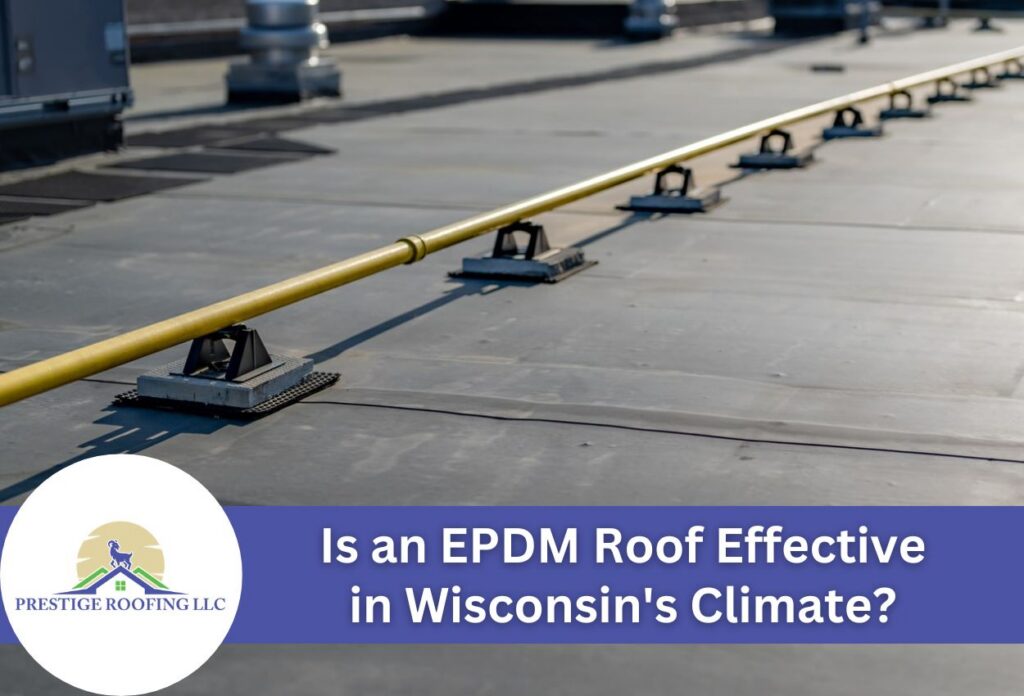

EPDM is one of the most effective low-slope roofing materials for Wisconsin’s climate, largely because it stays flexible down to below -49 degrees Fahrenheit, well below even the coldest Wisconsin winter lows. That cold-weather flexibility matters here. Wisconsin winters regularly push nighttime lows below 20 degrees Fahrenheit, and the material needs to bend and stretch through those drops without cracking or splitting at the seams.
Wisconsin puts roofs through serious stress year-round. Roofs face temperature-driven expansion and contraction cycles each winter. Add heavy snowfall, the risk of ice dams, and summer highs that average around 82 degrees Fahrenheit, and the total temperature swing from season to season can exceed 60 degrees Fahrenheit. That range damages stiff or brittle materials fast.
That said, EPDM’s effectiveness depends heavily on installation quality, roof complexity, and how well the system is maintained over time. Finding a reputable contractor who understands EPDM and the common problems that Wisconsin property owners encounter can help you decide whether EPDM is the right fit for your roof.
How Do EPDM Roofs Hold Up Against Wisconsin’s Freeze-Thaw Cycles and Snowfall?
EPDM handles Wisconsin’s winter stress better than most rigid roofing materials because its rubber composition expands and contracts without cracking, even through the freeze-thaw cycles in winter. Modified bitumen and built-up roofing materials become brittle in sustained sub-freezing temperatures, making them far more prone to cracking at the seams during those hard cold snaps. EPDM stays pliable through those same conditions without losing structural strength.
A properly installed EPDM roof can handle Wisconsin’s typical snow accumulation without issue. The risk comes from poor drainage. Low-slope roofs with less than ¼ inch of slope per foot are especially prone to ponding water that freezes as temperatures drop overnight. That repeated freeze-and-thaw cycle is one of the leading causes of early failure on flat roofs in this region. For Wisconsin applications, 60-mil is the minimum recommended membrane thickness, and 90-mil is the better choice for roofs with openings, curbs, or irregular geometry where seam and flashing stress concentrates.
EPDM roof performance in cold climates is well documented across the Upper Midwest, which is a large part of why it remains one of the dominant commercial choices from Milwaukee to Green Bay. EPDM is widely reported to retain the large majority of its tensile strength over decades in cold climates when properly installed, which few competing single-ply materials can match at a comparable cost point.
What Are the Most Common EPDM Flat Roof Problems in Wisconsin Winters?
Seam and flashing failures account for an estimated 80% to 90% of all EPDM roof leaks, making installation quality at the joints the highest-risk variable in Wisconsin’s cold, wet winters. Understanding which problems are climate-driven, installation-related, or maintenance-related helps property owners know what they can and cannot control.
- Seam separation from temperature movement: Temperature-driven expansion and contraction cycles in winter put repeated stress on seam edges. When adhesive or tape is applied incorrectly during installation, that stress eventually pulls seams apart and allows leaks to develop. This is an installation-related failure.
- Flashing failures at openings and parapet walls: Pipe boots, curbs, and wall terminations are the points where the roof transitions to another surface, and those transitions flex differently. Poor detailing at these spots allows water behind the flashing, often going undetected until interior damage appears. Seam and flashing failures together represent the vast majority of EPDM leaks. This is primarily an installation issue.
- Ice dam formation at low-drainage edges: Roofs with a slope of less than ¼ inch per foot hold standing water that freezes overnight along edges and drains. Adding continuous insulation beneath the assembly significantly reduces the heat loss that drives ice dam formation. This is a climate-driven problem that better insulation helps reduce.
- Punctures from foot traffic and maintenance: Walking on unprotected EPDM while clearing snow or during routine HVAC servicing commonly punctures the material. Sharp equipment or tools dragged over the surface can easily pierce even a 60-mil material. This is a maintenance-related failure that walk pads can help prevent.
- UV degradation accelerating edge shrinkage: Over time, prolonged UV exposure breaks down the surface, causing it to shrink back from the edges and expose adhesive seams. Shrinkage typically becomes a visible problem after 15 to 20 years without recoating, and it accelerates in roofs lacking proper ballast or coating protection. This is a climate and maintenance-related failure.
Most EPDM flat roof problems in Wisconsin winters trace back to either corners cut during installation or deferred maintenance that lets small issues grow into full failures. Catching seam and flashing problems early, ideally during a commercial roof inspection each spring and fall, is the most direct way to extend your roof’s lifespan.
How Long Does an EPDM Roof Last in Midwest Winters, and How Does It Compare to Alternatives?
A properly maintained EPDM roof in Wisconsin routinely lasts for at least 20 years, outpacing modified bitumen by 5 years or more and meeting PVC at a lower installed cost. The table below compares the four most common low-slope membrane options on lifespan, cold-weather flexibility, installation costs in Wisconsin, and warranty length.
| Membrane Type | Typical Lifespan in Wisconsin | Cold-Weather Flexibility | Approximate Installed Cost per Sq. Ft. (Wisconsin) | Common Warranty Length |
|---|---|---|---|---|
| EPDM | 20 to 30 years | Excellent | $4.00 to $8.00 | 10 to 20 years |
| TPO | 15 to 25 years | Good | $5.00 to $9.00 | 10 to 20 years |
| Modified Bitumen | 15 to 20 years | Fair | $4.00 to $9.00 | 10 to 20 years |
| PVC | 20 to 30 years | Good | $6.00 to $11.00 | 10 to 20 years |
EPDM’s cold-weather flexibility rating is a direct result of the rubber composition that stays pliable through Wisconsin’s freeze-thaw cycles in winter. Neglected EPDM systems with unaddressed seam failures, however, often fail within 12 to 15 years regardless of membrane quality, which shows how much maintenance matters. For budget-conscious projects, roofs with fewer openings, or buildings where cold-weather durability outweighs summer energy efficiency, EPDM delivers more lifespan per dollar than TPO or PVC at its installed cost range of $4.00 to $8.00 per square foot. TPO and PVC offer better heat-reflective properties in summer but come at a higher cost without a meaningful cold-climate advantage over well-maintained EPDM.
What Does Installation Quality Actually Determine?
EPDM handles temperature-driven expansion and contraction well, but only when it’s installed as a fully adhered or mechanically attached system using manufacturer-approved seam tape or a two-part splice adhesive. While ballasted systems, where loose stone holds the material down, offer excellent UV and hail protection, fully adhered systems are generally preferred for new Wisconsin roofs. Finding a leak under ballasted systems is difficult and expensive, especially in winter. Ballasted systems also complicate snow removal and add significant structural weight that not all buildings can support.
The installation details that most determine long-term performance are straightforward but unforgiving if skipped. Seam overlaps must be a minimum of 3 inches and sealed with a two-part splice adhesive or self-adhering tape. Flashing terminations must be sealed within 1 inch of every opening, including pipe boots, curbs, and parapet walls. The roof deck must be built or tapered to a minimum of ¼ inch per foot to move water toward drains, as any standing water from rain or melted snow that remains 48 hours or more will void most manufacturer warranties. Wisconsin winters create constant opportunities for that condition to develop as snow melts during daylight hours and refreezes overnight.
A professional inspection biannually, once in spring and once in fall, is the recommended schedule for any EPDM low-slope roof in this climate. The fall inspection should pay particular attention to seams and flashing before the first hard freeze of the season, since that is when adhesive failures become leaks.
What Is the Long-Term ROI of an EPDM Roof for Wisconsin Property Owners?
EPDM delivers a lower annualized cost than modified bitumen or TPO despite sometimes costing more upfront. A 2,000-square-foot EPDM roof installed in Wisconsin at $6.00 per square foot runs $12,000 total, but spread over a 30-year lifespan, that works out to $400 per year. By comparison, modified bitumen installed at $5.25 per square foot costs $10,500 upfront but might only last 15 years. This pushes its annualized cost to $700 per year, which is the same annualized cost as TPO. Over the life of the roof, EPDM typically saves property owners roughly $300 per year compared to both modified bitumen and TPO.
| Material | Installed Cost (2,000 sq. ft.) | Example Lifespan | Annualized Cost per Year |
|---|---|---|---|
| EPDM | $12,000 (at $6.00/sq. ft.) | 25 years | $480 |
| TPO | $14,000 (at $7.00/sq. ft.) | 20 years | $700 |
| Modified Bitumen | $10,500 (at $5.25/sq. ft.) | 15 years | $700 |
One trade-off worth knowing: EPDM’s black surface can increase summer cooling expenses by 10% to 15% compared to white TPO roofing membranes. While a black roof can absorb some solar heat in fall and spring, Wisconsin’s winter snow cover blocks solar absorption during the coldest months. Therefore, material color should be chosen based on your building’s specific HVAC system and local code requirements, not winter heating expectations.
Ready to Find Out If EPDM Is the Right Roof for Your Wisconsin Property?
Knowing that EPDM’s annualized cost runs roughly $400 per year over a 30-year lifespan is useful, but the right material for your building depends on your actual roof slope, drainage setup, insulation depth, and how many openings the material has to work around. Prestige Roofing LLC works with Wisconsin property owners on low-slope roofing systems and offers professional roof inspections to determine whether EPDM, TPO, or another option fits your specific conditions.
Not ready to schedule? Learn more about EPDM roofing services.