Roof Drain vs. Scuppers on a Commercial Flat Roof: Which Is Right for You?
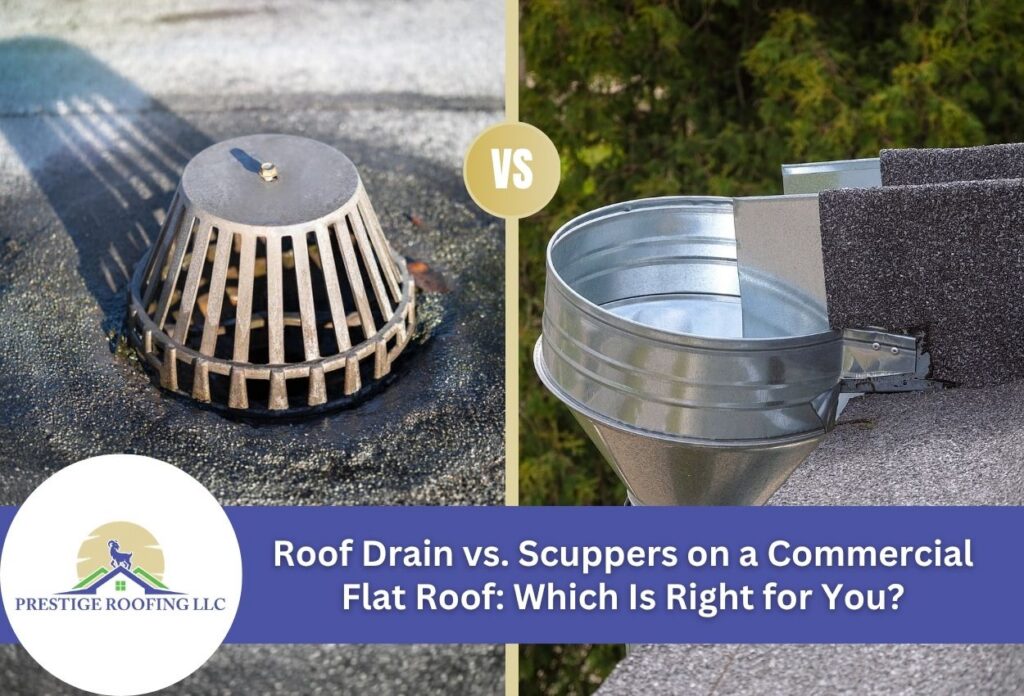

A roof drain collects water at a low point and moves it through interior piping, while a scupper is an opening in a parapet wall that discharges water directly outside. Interior drains connect to a concealed storm drainage system running through the building. Scuppers discharge to the exterior, typically into a downspout, leader head, or splash block. Both systems appear regularly on commercial flat and low-slope roofs across Green Bay, especially on buildings with parapet walls.
Under the International Plumbing Code, adopted by Wisconsin’s Commercial Building Code, most commercial flat roofs must have both a primary drainage system and a secondary overflow system. Scuppers frequently serve the overflow role, set above the primary drain elevation and sized to handle design stormwater flow when primary outlets are blocked or overwhelmed.
*Please note that price ranges listed in this article may not reflect the final cost of your project. Prices are subject to change based on various factors such as local labor rates, material quality, and more. All costs established in this article are rough estimates based on average industry rates.
How Do Roof Drains and Scuppers Actually Work, and How Do They Work Together on Commercial Buildings?
On most Green Bay commercial buildings with parapet walls, interior drains handle primary drainage while scuppers are set 1 to 2 inches above the roof membrane surface to serve as overflow. That elevation difference is intentional and code-driven.
| Feature | Roof Drain | Scupper |
|---|---|---|
| Drainage Location | Interior low point | Parapet wall opening |
| Discharge Path | Interior storm piping | Exterior downspout or splash block |
| Typical Opening Size | 3 to 6-inch diameter | 4 to 6-inch minimum width (IPC scupper sizing) |
| Primary vs. Overflow Role | Primary drainage | Overflow / secondary drainage |
| Freeze Vulnerability | High interior pipe freezing risk | High exterior ice dam risk at opening |
Both systems carry real freeze risk in Green Bay winters, just in different places. Interior drains can freeze where pipes run through unheated spaces, while scuppers collect ice at the parapet wall opening and block discharge when temperatures drop.
Relying on scuppers alone without adequate slope directing water toward the opening creates ponding risk during heavy rain or rapid snowmelt. The dual-system setup exists precisely because one system can fail or become overwhelmed. When primary drains clog with debris, the scupper set 1 to 2 inches above the membrane becomes the last line of defense against standing water and structural overload.
What Are the Pros and Cons of Interior Roof Drains vs. Scuppers on a Commercial Flat Roof?
Interior roof drains handle large roof areas more reliably than scuppers, but they cost more to install and carry greater risk if interior pipes leak or clog. Each system has real trade-offs that matter in Green Bay’s climate.
| Factor | Interior Roof Drains | Scuppers |
|---|---|---|
| Installation Cost | Higher interior piping adds labor and materials | Lower wall opening, no buried piping |
| Drainage Capacity | Handles large roof areas efficiently with multiple drain placements | Limited flow capacity on large roofs |
| Pipe/Leak Risk | An interior pipe leak can damage ceilings and the structure | No interior piping exposure |
| Clog Impact | One clog affects the entire drainage path | Debris blocks wall opening; easier to spot |
| Visual Inspection | Interior piping harder to inspect | Easy to visually inspect from the outside |
| Slope Control | Multiple drain placement allows precise slope control | The slope must direct water toward the parapet wall |
| Appearance | Hidden piping keeps the roofline clean | Exterior discharge visible at the wall |
| Retrofit Suitability | Complex to add on to existing buildings | Well-suited for retrofit parapet walls |
| Wisconsin Freeze Risk | Pipes in unheated spaces can freeze | Ice bridging blocks opening at parapet wall |
In Green Bay, scuppers on north-facing or shaded parapet walls are especially prone to ice bridging from October through March. The most dangerous scenario happens when rapid snowmelt is followed by an overnight refreeze, the scupper opening ices over completely, cutting off overflow capacity at the exact moment it’s needed most.
Scuppers work well on smaller roofs or as overflow outlets, but they should not be the only drainage option on large commercial roofs in northeastern Wisconsin, where temperature changes create recurring blockage risk. If a building currently relies only on scuppers, a qualified roofer should assess whether the system meets current overflow and primary drainage requirements.
How Are Scupper Drain Sizes and Roof Drain Counts Determined for a Commercial Roof in Wisconsin?
The International Plumbing Code sizes roof drainage based on local design rainfall intensity, and for Green Bay, that figure is approximately 3.2 inches per hour, based on a 1-hour, 100-year storm. That number drives the math behind how many drains a roof needs and how large each scupper opening must be to handle peak stormwater flow without backing up.
The 3.2 inches per hour rate sets the baseline, but code requirements add more specifics on top of it. IBC Section 1511 and IPC Chapter 11 both require secondary overflow drainage on commercial roofs with interior drains. When scuppers serve that overflow role, they must typically be set at or above the primary drain rim elevation plus 2 inches. Minimum scupper opening width is commonly 4 inches, and the opening depth cannot be less than the calculated flow depth for the drainage area it serves.
Wisconsin Code and Brown County Permit Requirements
Wisconsin’s Commercial Building Code adopts both the IBC and IPC with state-level amendments, so those federal baseline rules apply here, but local review adds another layer. Projects in Brown County require permit review that includes drainage calculations, not just a general plan submission.
Sizing a drainage system by estimate rather than calculation is one of the most common mistakes on commercial re-roofing projects, and in Green Bay, where heavy spring rain can follow a frozen scupper overnight, an undersized system creates real structural risk. Always confirm drain counts and scupper sizing with a licensed roofing contractor or engineer before finalizing any drainage plan.
Which Drainage System Is Better for a Flat Roof: Roof Drain vs. Scupper Based on Building Type and Climate?
Neither interior drains nor scuppers are universally better; the right choice depends on roof area, parapet configuration, interior plumbing access, and local climate exposure. In Green Bay, where annual snowfall averages 50 to 60 inches and rapid melts can follow hard freezes overnight, that decision carries real consequences for building safety.
- Choose interior roof drains when the roof area exceeds 5,000 sq ft. Larger roofs generate runoff volumes that scuppers alone cannot handle reliably, especially during heavy spring rain or fast snowmelt.
- Choose interior drains when the roof slope can be directed to interior low points. Multiple drain placement gives precise slope control and reduces the chance of ponding in flat areas away from the parapet wall.
- Choose interior drains when the building has accessible interior plumbing chases. Concealed piping keeps the roofline clean and avoids exterior discharge at ground level.
- Choose scuppers as primary drainage when the roof area is under 3,000 sq ft. Smaller roofs generate lower runoff volumes, and a parapet wall opening with an exterior downspout or splash block handles that weight without the added cost of buried interior piping.
- Choose scuppers as primary drainage when no interior plumbing chase is available. Retrofitting interior drain piping through an existing building is complex and expensive; scuppers are far better suited for parapet-wall retrofits on existing structures.
- Use a dual system of interior drains plus overflow scuppers on any Green Bay commercial roof with parapet walls. Scuppers set 1 to 2 inches above the primary drain elevation serve as the last line of defense when primary drains clog or are overwhelmed during a peak storm.
For most Green Bay commercial roofs above 3,000 sq ft, interior drains paired with overflow scuppers are the preferred setup. Scuppers alone carry real ice-blockage risk during late-winter melts; north-facing or shaded parapet walls can ice over completely, cutting off overflow capacity when it is needed most. A licensed commercial roof inspector can assess whether a building’s current drainage layout meets both drainage volume requirements and Wisconsin’s overflow provisions.
What Does It Cost to Install or Retrofit Roof Drains vs. Scuppers on a Commercial Building?
Interior roof drains cost more per unit and require $2,000 to $8,000 in additional interior storm drain piping, but they typically extend roof membrane life by 5 to 10 years compared to roofs with poor drainage, a trade-off that matters on any 10,000 sq ft replacement job.
| System Type | Installed Cost Per Unit | Typical Unit Count (10,000 sq ft) | Estimated Total Installed Cost | Average Service Life |
|---|---|---|---|---|
| Interior Roof Drain | $400 to $900 per drain | 4 to 6 drains | $1,600 to $5,400 | 20 to 30 years |
| Primary Scupper | $200 to $500 per opening | 4 to 8 openings | $800 to $4,000 | 20 to 30 years |
| Overflow Scupper | $150 to $400 per opening | 4 to 8 openings | $600 to $3,200 | 20 to 30 years |
| Interior Drain Retrofit | $600 to $1,200 per drain | 4 to 6 drains | $2,400 to $7,200 | 20 to 30 years |
| Interior Storm Drain Piping (mid-size building) | Full building run | $2,000 to $8,000 | 30 to 50 years | |
| Exterior Leader Heads, Downspouts, or Splash Blocks | $150 to $400 per location | 4 to 8 locations | $600 to $3,200 | 15 to 25 years |
Scupper systems cost less upfront, but they require exterior discharge hardware at every opening,g leader heads, downspouts, or splash blocks at $150 to $400 per location add up fast on buildings with multiple parapet walls. Interior drain retrofits run $600 to $1,200 per drain because ceiling access for existing buildings adds labor time.
On a 10,000 sq ft TPO or EPDM roof replacement costing $40,000 to $70,000, extending membrane life by 5 to 10 years through proper interior drainage represents tens of thousands of dollars in avoided replacement costs. That math makes a properly sloped interior drain system with overflow scuppers one of the highest-return investments on any commercial flat roof in Green Bay.
What Are the Warning Signs That Your Commercial Roof Drainage Is Failing Drains or Scuppers?
Standing water that remains on a flat roof more than 48 hours after rain or snowmelt is the clearest sign that a drainage system is failing, whether the roof uses interior drains, scuppers, or both. Blocked drains add weight fast: ponding can exceed 5 lbs per square foot for every inch of water depth, which puts real stress on structural roof decking in older commercial buildings.
- Standing water after 48 hours: Any water still pooling on the roof membrane 48 hours after a storm or melt means the drainage system is not moving water fast enough. Inspect drains and scupper openings immediately.
- Water staining or rust streaks on exterior walls: Rust-colored streaks running down the building facade below a scupper opening signal that the scupper is intermittently blocked or too small to handle peak flow.
- Interior ceiling stains near columns or drain locations: Water intrusion appearing at ceiling level near interior columns typically points to a failed or blocked interior drain, not a membrane leak.
- Sagging or deflection around drain sumps: Visible dips or wrinkles in the roof membrane around a drain sump mean ponding water is stressing both the membrane and the roof decking beneath it.
- Clogged or missing drain strainers: A drain strainer packed with debris or removed entirely allows leaves, gravel, and sediment to enter the interior piping, leading to slow drainage or full blockage.
- Scupper openings packed with debris or ice: Scupper openings on north-facing or shaded parapet walls are especially prone to ice bridging from October through March in Green Bay, cutting off overflow capacity during rapid snowmelt.
- Efflorescence on parapet masonry near scuppers: White chalky deposits on brick or block near a scupper opening indicate chronic water contact, a sign the scupper is backing up regularly rather than draining freely.
Roof drains should be inspected and cleared at a minimum twice per year, before winter freeze-up in October and after spring snowmelt in April, with scupper openings checked after every major storm. Catching a blocked drain or iced scupper early costs far less than repairing structural roof decking damaged by repeated ponding.
Ready to Solve Your Commercial Roof Drainage Problem in Green Bay?
Catching a blocked drain early costs far less than repairing structural roof decking damaged by repeated ponding, and building owners in Green Bay and Brown County deal with that risk every winter. Prestige Roofing LLC works with commercial property owners and facility managers across northeast Wisconsin on drain installation, scupper retrofitting, and full commercial roof replacements with properly engineered drainage systems that meet Wisconsin Commercial Building Code overflow requirements.
Getting the right drainage layout on a flat commercial roof protects the membrane, the roof decking, and the building, and a qualified local inspection is the right first step.
Schedule your free roof inspection.
Not ready to schedule? Learn more about commercial roofing drainage systems.